
The High-Stakes Duel: Can AI Content Outperform Manual Writing for Eshop SEO Growth?
In the relentlessly competitive world of online retail, visibility is the currency of survival. For store owners and marketing managers, the battle for the top spot on Google Search results is constant. Every product description, category page, and blog post is a soldier on the front lines. This brings us to the defining debate of our time: Eshop Seo – AI Content for eshops vs manual writing.
For decades, “content is king” meant hiring expensive teams of copywriters to painstakingly craft unique narratives. However, with the explosion of Large Language Models (LLMs) and specialized tools like EshopSEO, the landscape has shifted. The question is no longer just about quality; it is about scale, speed, and Return on Investment (ROI). This deep-dive comparison examines whether automated AI generation or human-crafted copy offers the superior ROI for e-commerce stores looking to dominate search rankings.
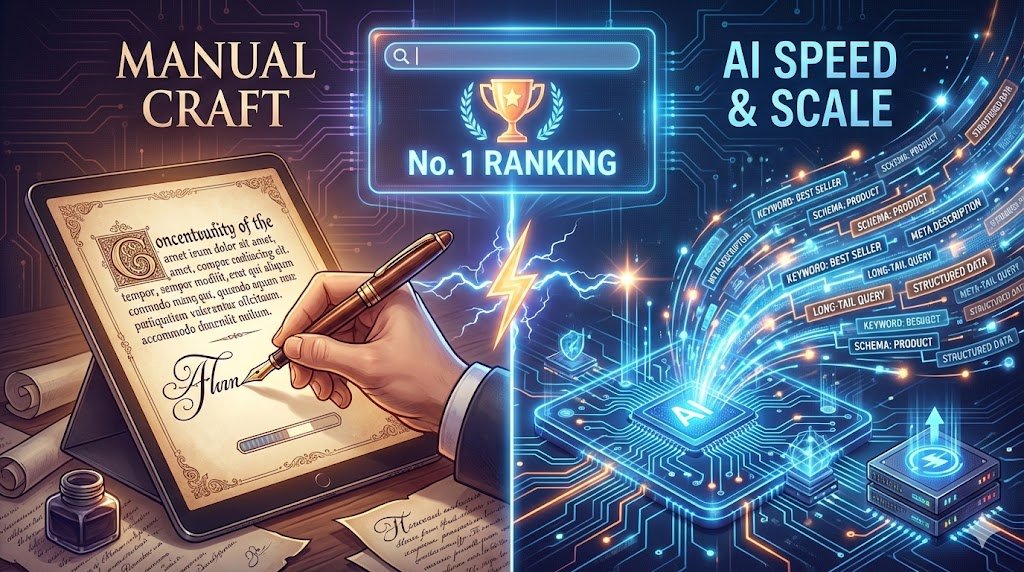
The Evolution of E-commerce SEO: Human Touch vs. Machine Precision
Defining the current landscape of digital commerce
The digital commerce ecosystem has evolved from simple online catalogs to complex, algorithm-driven marketplaces. Today, search engines like Google look for topical authority, site structure, and fresh content. Furthermore, the rise of AI Overviews and Search Generative Experience (SGE) means that your content isn’t just being read by humans; it is being digested by machines to formulate direct answers.
Why traditional copywriting is struggling to scale
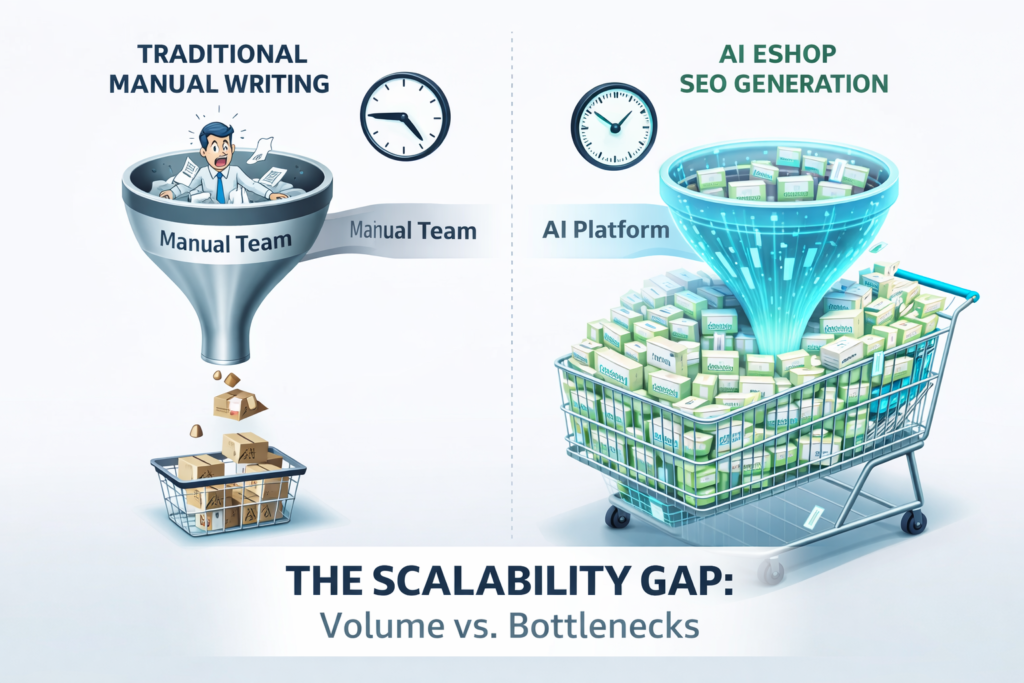
The traditional model of manual copywriting faces a significant bottleneck: human capacity. An excellent writer might produce two or three high-quality blog posts or perhaps twenty product descriptions in a day. If your store has a catalog of 5,000 SKUs, relying solely on manual writing is a logistical nightmare. It is slow, prone to inconsistency across large batches, and incredibly expensive. In an era where being first to market can define success, the delay caused by manual editorial processes can result in lost revenue.
Understanding the Search Intent: Transactional Gravity in E-commerce
Why ‘Buying Intent’ keywords demand specialized content structures
In e-commerce, not all traffic is equal. Transactional search intent—where the user is ready to buy—requires a specific content structure. It needs to be persuasive, concise, and technically optimized with schema markup. While a human writer can craft a beautiful story, they may miss the precise keyword density or structural requirements that search engine bots crave to rank a page for transactional queries.
How EshopSEO.com aligns content with the buyer journey
This is where specialized tools come into play. A generic AI might write a poem, but an AI SEO Content Generator for Ecommerce Websites understands the mechanics of a sale. By analyzing competitor keywords and aligning content with the specific stage of the buyer’s journey, automated solutions ensure that every generated article serves a purpose: moving the user from “interested” to “add to cart.”
The Case for AI-Driven Content Generation
Unprecedented Scalability for Bulk Product Catalogs
The primary advantage of AI in the Eshop Seo – AI Content for eshops vs manual writing debate is sheer scalability. Imagine launching a new seasonal collection with 500 items. A manual team would need weeks to write unique descriptions for each. An AI-driven system can handle managing thousands of SKUs without human burnout, ensuring that every product goes live with SEO-rich content immediately. This eliminates the dreaded “thin content” penalty that plagues many large e-commerce sites.
Hyper-Optimization for Modern Search Engines
Modern AI tools do not just write; they analyze. They offer built-in competitor keyword analysis and placement, ensuring that your content statistically matches what Google is currently rewarding. Instead of guessing which keywords might work, AI tools can crunch data from top-ranking pages and integrate those semantic relevance signals directly into your text naturally.
Gaining Citations in the Age of AI Overviews (SGE)
We are entering a new era where users ask ChatGPT or Gemini for product recommendations. To be visible here, your content needs to be structured in a way these models understand. EshopSEO specializes in structuring data for ChatGPT, Gemini, and Perplexity visibility. This involves creating authoritative, fact-based content that these LLMs cite as the source of truth, effectively getting your products recommended by the AI itself.
The Case for Manual Copywriting
Creative Storytelling and Unique Brand Voice
Despite the advancements in technology, there is still an arena where humans excel: creative storytelling. The limitations of standard LLMs in replicating niche personality or highly idiomatic brand voices are real. If you are selling a luxury lifestyle product where the emotional connection is the primary selling point, the nuances of a human writer can be invaluable for the “About Us” page or the hero banner copy.
Deep Subject Matter Expertise (SME)
For high-ticket B2B items or complex technical equipment, deep Subject Matter Expertise (SME) is often required. When a human touch is non-negotiable for high-ticket items, it is usually because the buyer needs to trust the specific expertise of the author. However, even in these cases, the manual writer can be significantly aided by AI outlines and research.
Direct Comparison: Cost-Benefit and ROI Analysis
Production Speed: Rapid Deployment vs. Editorial Bottlenecks
Speed is a critical factor in ROI. AI enables rapid deployment. You can populate a blog with 30 relevant articles in the time it takes to brief a writer on one. This speed allows for faster indexing by search engines, meaning traffic starts flowing sooner.
Cost Per Lead: Comparing Agency Fees to EshopSEO Subscription Tiers
The starkest contrast appears in the financials. A decent SEO agency or freelance copywriter might charge anywhere from $100 to $500 per optimized article. In contrast, leveraging transparent pricing structures from platform-based solutions changes the economics entirely.
For example, EshopSEO’s Starter plan costs just €29 per month, offering 10 articles and a 3-month content calendar for solo e-shop owners. For larger operations, the Growth plan at €79 per month provides 30 articles and covers 5 projects. Even immediately, the cost per unit drops from hundreds of dollars to just a few euros, drastically improving the ROI per piece of content.
Bridging the Gap: The Hybrid Approach to E-commerce Dominance
Using AI for Heavy Lifting and Humans for Final Polish
The smartest e-commerce managers do not view it as a zero-sum game. They use a hybrid approach. They utilize AI for the heavy lifting—research, structure, keyword optimization, and first drafts—and use humans for the final polish. This ensures the output is 90% faster and cheaper to produce while retaining the 10% of human flair that ensures brand alignment.
Automatic Internal Linking: The Secret Sauce for Ranking
One of the most tedious aspects of manual SEO is internal linking. Writers often forget to link to older products or struggle to find the right anchor text. EshopSEO solves this with automated linking structures. By intelligently interlinking your articles and product pages, the tool passes “link juice” throughout your site, improving crawlability and authority without manual intervention.
Technical SEO Integration: Beyond the Words
WordPress Integration and Workflow Automation
Content is useless if it sits in a Google Doc. Workflow automation is key. EshopSEO offers seamless integration where done-for-you SEO articles with product links are published directly to WordPress. This removes the copy-paste administrative burden, allowing store owners to focus on fulfillment and strategy rather than CMS management.
Fact-Checking and E-E-A-T Compliance in AI Outputs
Google evaluates content based on Experience, Expertise, Authoritativeness, and Trustworthiness (E-E-A-T). Ensuring Expertise and Trustworthiness in automated articles is handled by EshopSEO through rigorous data sourcing and competitor analysis features. Unlike generic chat bots that “hallucinate,” specialized SEO AI is grounded in the actual search data of your niche.
Case Study/Scenarios: Which Method Should You Choose?
When to Choose Manual Writing (Bespoke/Luxury Goods)
If you run a boutique store selling hand-made jewelry with a catalog of only 10 items, manual writing is appropriate. The volume is low, and the brand story is everything. The cost of hiring a writer is justifiable because the content volume cap is low.
When to Choose AI Generation (Growth Hacking/Large Inventory/Agencies)
If you are a marketing team managing 5 projects, or an agency with 50 clients, manual writing is impossible to scale profitably. Here, the Agency plan from EshopSEO (€149/month for 100 articles) is the clear winner. It allows for the management of 50 projects and includes priority support, ensuring that you can dominate niche markets through sheer volume and topical authority.

Leveraging EshopSEO for Maximum Visibility
To truly outpace competitors, you need a strategy that never sleeps. Using the AI SEO Content Generator for Ecommerce Websites allows you to run your content strategy on auto-pilot. The tool doesn’t just write; it plans.
With features like a 3-month content calendar included in all plans, you are not just reacting to trends; you are preparing for them. You can utilize tailored strategy features to dominate niche markets by covering every possible question your customers might ask, linking those answers directly to your products, and signaling to Google that you are the authority in your space.
Frequently Asked Questions (FAQ)
Does Google penalize AI content in e-commerce results?
No, Google has explicitly stated they reward high-quality content regardless of how it is produced. The key is value. If the AI content answers the user’s query and provides a good experience, it will rank. EshopSEO optimizes for this specific quality standard.
How does AI content help with ‘Search Generative Experience’ citations?
AI models like Gemini and ChatGPT prefer structured, factual, and authoritative content. EshopSEO formats articles specifically to be easily parsed by these models, increasing the likelihood that your store is cited as a recommendation in AI-generated answers.
Is AI content suitable for product descriptions and blog posts alike?
Yes. It is particularly effective for blog posts that require research and structure (like “Top 10” lists or “How-to” guides). For product descriptions, it ensures consistency and keyword inclusion across thousands of SKUs.
Can I integrate AI-generated content directly into my WordPress store?
Absolutely. EshopSEO provides a feature to auto-publish directly to WordPress, complete with internal links to your products, saving hours of manual uploading time.
Conclusion: The Future of Eshop SEO is Automated
In the high-stakes duel between Eshop Seo – AI Content for eshops vs manual writing, the winner is determined by your goals. If you want expensive art, choose manual. But if you want scalable growth, traffic, and revenue, AI is the undisputed champion.
The ROI provided by automated solutions like EshopSEO—offering unlimited outlines, automatic internal linking, and competitor analysis—far outstrips what manual teams can achieve alone. By adopting a tool that costs less than a single hour of a consultant’s time (starting at just €3 to try), you can turn your e-commerce store into a traffic-generating machine. The future of e-commerce belongs to those who scale, and automation is the engine of that growth.