
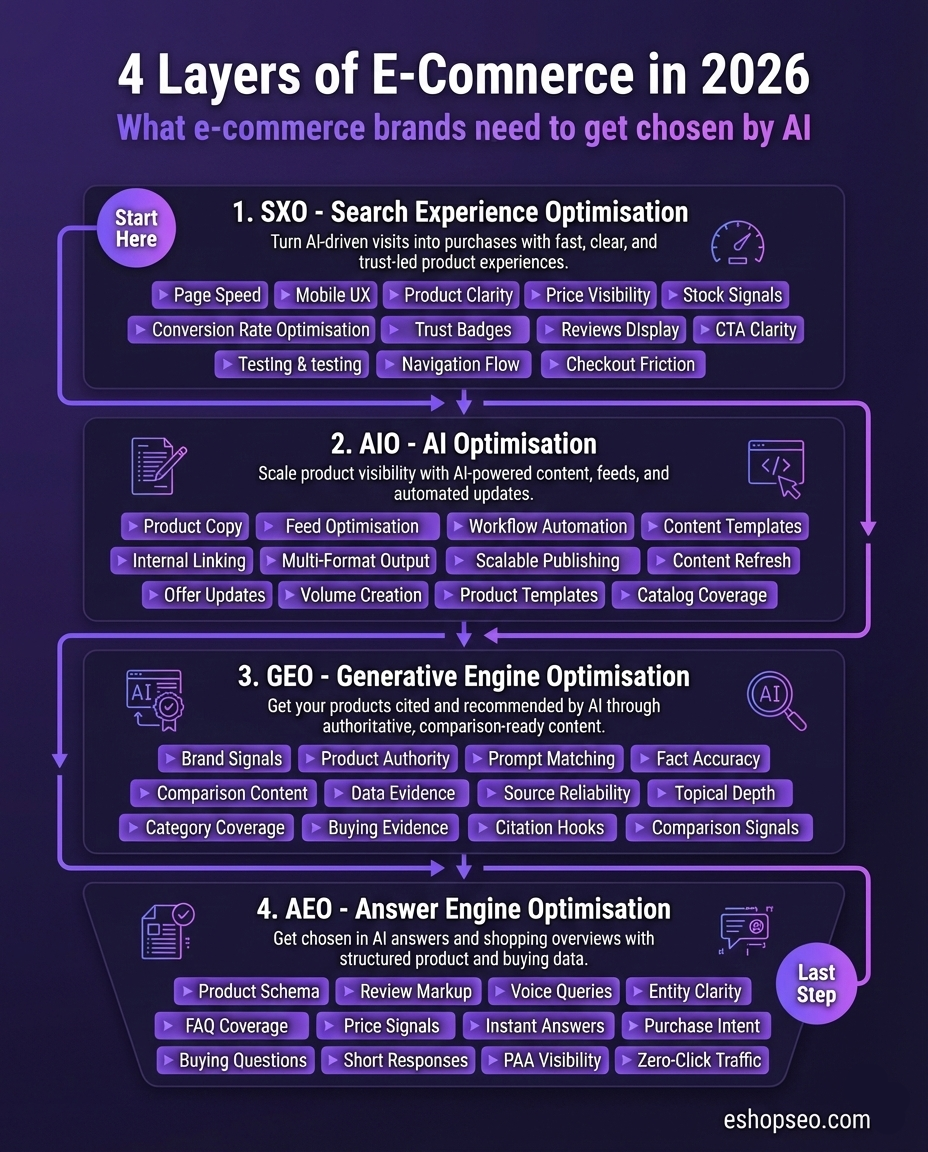
The landscape of digital retail is undergoing its most radical transformation since the invention of the search engine. As we navigate 2026, the traditional playbook of keyword stuffing and backlink hoarding has been superseded by a more complex, multi-dimensional framework: AI search optimization for ecommerce. No longer is it enough to simply appear on a results page; today, your brand must be selected and synthesized by artificial intelligence engines that serve as the new gatekeepers of consumer attention.
In this new era, shoppers are moving away from manual browsing and endless scrolling through product listings. They are increasingly relying on “Answer Engines” and Generative Overviews to make purchasing decisions for them, fundamentally changing how discovery happens online. To stay competitive, brands must adapt to a four-layered strategy that ensures they are not just visible to humans, but preferred by the algorithms that now curate shopping experiences. At eShopSEO, we have pioneered the tools and methodologies to help online stores navigate this shift, providing automated, structured content solutions that bridge the gap between your products and the AI models recommending them.
Why E-Commerce SEO Is Being Rewritten in 2026
From Rankings to Recommendations
The era of the “10 blue links” is officially a relic of the past. For decades, SEO was a game of visibility – getting your URL into the top three spots of a Google Search Results Page (SERP). Brands obsessed over PageRank, domain authority, and exact-match anchor text. Success meant appearing above the fold, ideally in position one, where you could capture the lion’s share of organic clicks. Today, the interface has shifted toward AI-generated answers and shopping overviews that fundamentally redefine what “winning” means.
When a user asks a question today, platforms like ChatGPT, Google AI Overviews (formerly SGE), Gemini, and Perplexity don’t just provide a list of websites. They provide a definitive answer, often synthesized from multiple sources. They compare prices directly within the interface, summarize thousands of reviews into digestible insights, and offer a curated selection of products without requiring the user to click through to a single website. In many cases, the user’s question is answered completely within the AI interface itself – what the industry now calls “zero-click” searches.
This shift represents a move from visibility to selection. In 2026, being “number one” on Google doesn’t guarantee a click if the AI Overview at the top of the page recommends three of your competitors instead. The search result page itself has been transformed: where you once competed for ten positions, you now compete to be one of three or four sources cited within an AI-generated paragraph that appears before any traditional links. Your goal is no longer just to be found; it is to be the brand that the AI trusts enough to recommend as the primary solution to the user’s specific need.
The New Question AI Asks About Your Store
To understand how to optimize for this new world, we must understand the “logic” of the AI. When an AI agent crawls your e-commerce store, it isn’t just looking for keywords or counting backlinks. It is evaluating your store based on a specific set of criteria that determine trustworthiness, relevance, and utility:
- Can this product be trusted? AI looks for social proof through verified reviews, consistent data across multiple web properties, and recognition from authoritative third-party sources. If your product information contradicts what appears on Amazon, manufacturer websites, or expert reviews, the AI flags your source as potentially unreliable.
- Is the information accurate and up to date? Outdated prices, discontinued products marked as available, or “out of stock” items without clear restock dates lead to poor user experiences. AI engines have sophisticated methods of detecting stale data, and they quickly learn to de-prioritize sources that frequently provide inaccurate information.
- Is there buying intent evidence? The AI analyzes whether your content helps a user move from “curious” to “ready to buy”. This means clear pricing, transparent shipping costs, straightforward return policies, and unambiguous calls-to-action that reduce friction in the purchasing journey.
- Is this brand authoritative in its category? Through the lens of E-E-A-T (Experience, Expertise, Authoritativeness, and Trustworthiness), AI determines if you are a leader or a laggard. The first “E” stands for Experience – first-hand knowledge that demonstrates you actually use, test, or intimately understand the products you sell. This is particularly crucial for product recommendations and reviews.
Our platform is specifically designed to feed these AI models exactly what they need: structured, high-authority content that answers these four questions affirmatively and automatically. We help you build the E-E-A-T signals that AI engines actively seek when determining which brands deserve prominent placement in their generated responses.
Layer 1 – SXO (Search Experience Optimisation)
What SXO Means in an AI-Driven Search World
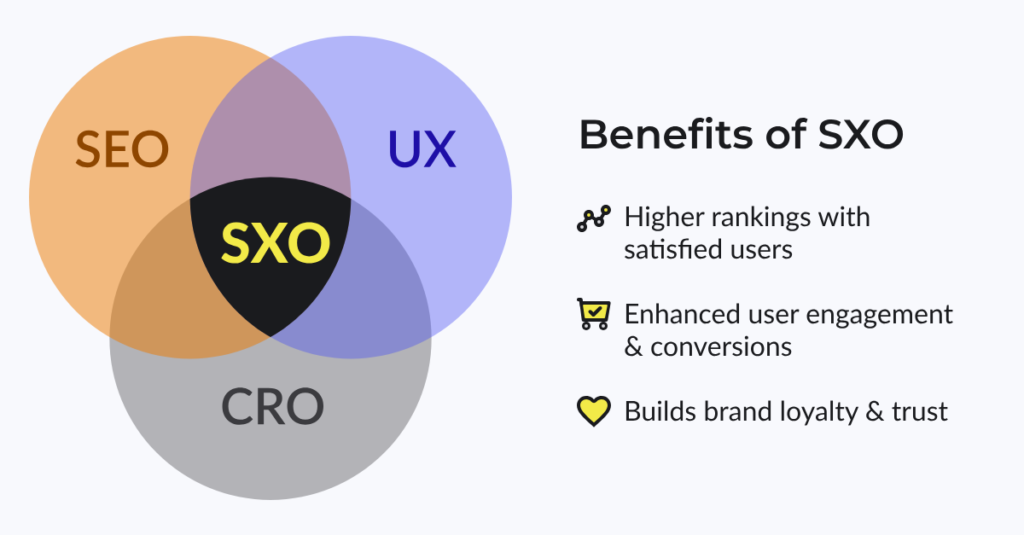
Before you can optimize for AI, you must optimize for the human experience that occurs after AI makes its recommendation. SXO (Search Experience Optimisation) is the evolution of traditional SEO that focuses on what happens after a user (or an AI agent) lands on your page. It recognizes that search engines – and now AI engines – evaluate not just your content, but how users interact with that content once they arrive.
In 2026, AI engines use “user signals” as a primary ranking factor. If an AI recommends your product and the user clicks through but immediately bounces because the page is slow, the layout is confusing, or the checkout process is frustrating, the AI learns that your store is a “bad recommendation”. Consequently, your visibility in future AI-generated responses will plummet. Think of it this way: every user who clicks through from an AI recommendation and has a poor experience is training that AI to stop recommending you. SXO is the foundation upon which all other layers are built.
Core SXO Signals That Matter
To win in the SXO layer, e-commerce brands must master several critical signals that directly impact both human satisfaction and AI evaluation:
- Page Speed: In an age of instant gratification, a one-second delay can result in a 20% drop in conversions. Google’s Core Web Vitals – specifically Largest Contentful Paint (LCP), Interaction to Next Paint (INP), and Cumulative Layout Shift (CLS) – have become essential benchmarks. AI models prioritize fast-loading sites because they provide a better “handoff” for the user they’re serving. An LCP under 2.5 seconds is now table stakes for competitive e-commerce.
- Mobile UX: With the majority of AI interactions happening on mobile devices, your store must be thumb-friendly and lightning-fast on cellular networks. This means responsive design isn’t optional – it’s fundamental. Button sizes must accommodate touch accuracy, text must be readable without zooming, and forms must be simplified for mobile input.
- Product Clarity & Price Visibility: AI crawlers need to find the price and product features instantly. If this data is buried in images, hidden behind complex JavaScript that requires multiple user interactions to reveal, or inconsistently formatted across pages, the AI might miss it entirely or, worse, extract incorrect information. Clear, structured presentation of prices, specifications, and availability signals professionalism and reliability.
- Stock Signals: Real-time inventory data is crucial for maintaining AI trust. Recommending an out-of-stock item is a failure for an AI engine, and repeated failures lead to permanent de-prioritization of your store as a source. Implement schema markup that clearly communicates inventory status and expected restock dates when applicable.
- Trust Badges & Reviews: High-quality, structured reviews using Schema.org Review markup allow AI to summarize the “pros and cons” of your product for the user. The AI can extract aggregate ratings, common complaints, and frequently praised features to present a balanced recommendation. Without this structured data, your reviews remain invisible to AI analysis.
- Checkout Friction: The fewer the steps to buy, the higher your conversion rate, and the more “successful” the AI deems its recommendation. Abandoned cart rates serve as powerful negative signals. If AI-referred traffic consistently abandons at checkout, the AI interprets your store as unreliable or problematic.
SXO Checklist for E-Commerce Stores
To ensure your store is ready for the AI-driven traffic of 2026, follow this actionable checklist:
- Audit Core Web Vitals: Use Google PageSpeed Insights or Search Console to ensure your LCP (Largest Contentful Paint) is under 2.5 seconds, INP under 200 milliseconds, and CLS below 0.1.
- Implement High-Resolution, Compressed Images: Use WebP or AVIF formats to maintain quality without sacrificing speed. Implement lazy loading for below-the-fold images.
- Simplify Navigation: Can a user find any product within three clicks from your homepage? Test your information architecture with real users to identify friction points.
- Optimize for “Scanability”: Use bullet points, clear subheadings (H2/H3 tags), and highlighted key features for product descriptions that allow both humans and AI to quickly extract important information.
- Review Checkout UX: Implement one-click payment options like Apple Pay, Google Pay, or Shop Pay. Remove unnecessary form fields and offer guest checkout prominently.
- Live Chat/AI Bot Integration: Provide instant answers to user queries on-page to reduce bounce rates and capture hesitant buyers before they leave.
Layer 2 – AIO (AI Optimisation)
Why Manual SEO Can’t Scale Anymore
The sheer volume of data in modern e-commerce makes manual SEO impossible. If you have 5,000 SKUs, each requiring unique descriptions, meta tags, FAQ sections, and internal links to related products, a human team cannot keep up with the pace of change in 2026. Consider the dynamics: prices change daily based on competitor movements and inventory levels. Stock fluctuates hourly. Competitors launch new products every minute. Seasonal trends shift weekly. Manual optimization simply cannot maintain the pace required for competitive advantage.
This is where AIO (AI Optimisation) becomes essential. AIO is the use of artificial intelligence to manage and optimize your SEO efforts at scale, ensuring consistency, accuracy, and comprehensiveness across your entire catalog. This is the core mission of eShopSEO: we provide the automation necessary to ensure that every single product in your catalog is perfectly optimized for search engines and AI crawlers alike, without the exponential increase in human labor that would otherwise be required.
What AIO Actually Covers
AIO isn’t just about “generating text” using ChatGPT or similar tools. It’s about creating a sophisticated data ecosystem where content, structure, and optimization work in harmony. Our platform focuses on several critical capabilities:
- Product Copy at Scale: Generating thousands of unique, high-converting product descriptions that avoid “duplicate content” penalties while maintaining your brand voice and meeting SEO best practices. Each description incorporates relevant keywords naturally, highlights unique selling propositions, and addresses common customer questions.
- Feed Optimisation: Ensuring your Google Merchant Center feeds, Facebook Catalog feeds, and other product data sources are perfectly synced with your on-page data. Discrepancies between your website and your feed data create confusion for both users and AI engines.
- Workflow Automation: Automatically updating meta titles and descriptions based on seasonal trends, stock levels, or competitive positioning. For example, highlighting “In Stock – Ships Today” during high-demand periods or emphasizing price advantages when you’re currently the lowest-priced option for a particular product.
- Internal Linking: AI-driven algorithms that link related products, complementary items, and relevant blog posts to distribute “link juice” effectively across your entire catalog. Strategic internal linking helps establish topical authority and guides both users and AI crawlers through your content ecosystem logically.
- Multi-Format Output: Taking a single product’s data and transforming it into multiple content formats: detailed blog posts that rank for informational queries, comparison tables that appear in AI overviews, FAQ sections optimized for featured snippets, and even video scripts for YouTube optimization.
- Content Refresh: Automatically identifying and updating “decaying” content that has lost its ranking or relevance. AI can detect when product descriptions fall out of alignment with current search trends or when competitor content has surpassed yours in comprehensiveness.
AIO Done Right = Consistency + Accuracy
The biggest risk in 2026 is “hallucinating” or low-quality AI content that undermines your E-E-A-T signals. If your automated descriptions contain factual errors – incorrect specifications, overstated claims, or inconsistent pricing information – your brand’s trustworthiness will be destroyed in the eyes of both human customers and AI evaluators. A single instance of incorrect information can trigger a cascade of negative trust signals.
At eShopSEO, we emphasize Accuracy > Volume. We use strict templates derived from your actual product data, implement human-in-the-loop guardrails to catch errors before publication, and maintain version control to ensure consistency across all customer touchpoints. By using structured data and schema markup for products, prices, availability, and reviews, we make it easy for AI engines to verify the facts about your products against other authoritative sources. This verification process increases the likelihood of being cited in generative answers and featured in AI-curated product recommendations.
Layer 3 – GEO (Generative Engine Optimisation)
What Is GEO and Why It Matters Now
If SEO is about ranking in Google’s traditional search results, GEO (Generative Engine Optimisation) is about being the source that the AI cites when it answers a question. This represents a fundamental shift in how digital visibility works. In a traditional search, Google shows you a list of ten websites and lets you choose which to visit. In a generative search, the AI writes a paragraph, provides a direct answer, and includes “citations” or “sources” (often appearing as small icons, footnotes, or expandable source lists).
If your store is not among those citations, you effectively don’t exist in that search session. The user receives their answer, makes their purchasing decision, and moves on – all without ever knowing your brand exists. GEO is the art and science of making your content so authoritative, well-structured, and comprehensively useful that the AI must use it as a reference when constructing its response.
How AI Decides What to Cite
AI engines like Perplexity, ChatGPT, or Google Gemini don’t pick sources at random. They evaluate potential citations based on multiple sophisticated criteria:
- Brand Signals: Does this brand have a strong reputation across social media, forums (like Reddit), industry publications, and news sites? AI engines increasingly incorporate “social listening” data to gauge brand reputation. Negative reviews on third-party platforms, complaints in forums, or controversies in news articles all reduce your citation probability.
- Product Authority: Is this specific product mentioned in “Best of” lists compiled by reputable publications, expert reviews from industry authorities, or comparison guides on trusted sites? Products that appear repeatedly in authoritative contexts gain “citation momentum.”
- Prompt Matching: Does the content directly and concisely answer the specific prompt the user entered? AI engines favor sources that address questions head-on without requiring the reader to hunt for information or infer connections.
- Fact Accuracy: Does the information on the page match the consensus of other high-authority sites? AI engines cross-reference claims against multiple sources. Outlier information that contradicts the broader web consensus raises red flags unless supported by extraordinary evidence.
- Topical Depth: Does the page cover the topic comprehensively, or is it just a thin product page with minimal context? Shallow content rarely gets cited because it doesn’t provide sufficient value for the AI to confidently reference it.
GEO Content That Gets Cited
To win the citation game, you need more than just product pages. You need “bridge content” that connects user questions to your products in meaningful ways. In our platform we help brands generate:
- Comparison Content: “Product A vs. Product B” guides are goldmines for GEO because they directly address high-intent searches. Users comparing specific products are often in the final stages of their buying journey, and AI engines prioritize content that facilitates informed decisions.
- Buying Guides: Comprehensive resources like “How to choose the best [Category] in 2026” establish your brand as an educator, not just a vendor. These guides rank for informational queries that occur early in the customer journey, building brand awareness and trust before the user is ready to buy.
- Category Explainers: Deep dives into the technology, materials, or manufacturing processes behind your products demonstrate genuine expertise – the second “E” in E-E-A-T. For example, a coffee equipment retailer might publish detailed guides on burr grinder mechanisms, extraction temperature science, or the chemical properties of different roast levels.
- Data-Backed Insights: Original research, industry surveys, or proprietary data regarding your niche creates truly unique content that other sources will reference. This positions you as a primary source rather than a derivative one.
- Expert Commentary: Direct quotes and insights from named experts within your organization demonstrate “Experience” and “Expertise” – the first two components of E-E-A-T. Including author bios with credentials and relevant experience strengthens these signals.
GEO Signals That Increase Citation Probability
To increase your “citation score” and become a preferred source for AI-generated answers, ensure your content includes:
- Data Evidence: Use specific numbers, percentages, dates, and quantifiable comparisons rather than vague claims. “78% of users report satisfaction” is more citation-worthy than “most users are happy.”
- Buying Evidence: Include clear pricing information, realistic shipping timeframes, transparent return policies, and available payment options. AI engines favor sources that reduce uncertainty in the buying process.
- Citation Hooks: Use bolded “key takeaways,” summary boxes, quick-answer sections at the top of articles, and formatted FAQ sections that AI can easily scrape and present. Make it effortless for the AI to extract useful information.
- Category Coverage: Ensure you are covering the “long-tail” questions related to your niche, not just high-volume head terms. Comprehensive coverage across a topic cluster signals true expertise and increases the likelihood of being cited for related queries.
Layer 4 – AEO (Answer Engine Optimisation)
The Rise of Zero-Click Shopping Decisions
AEO (Answer Engine Optimisation) is the final frontier, focusing on zero-click searches – queries where the user gets the answer they need without ever leaving the search interface. In 2026, voice search via smart assistants (Alexa, Siri, Google Assistant, or Gemini) and shopping summaries displayed directly in search results are the primary drivers of AEO traffic.
Consider this scenario: a user says, “Hey Gemini, find me a waterproof hiking boot under $150 with good arch support”. The AI doesn’t give them a website to visit; it gives them an answer – possibly a single product recommendation complete with price, availability, and a link to purchase. If your product isn’t optimized for AEO, you aren’t even in the running for that sale. The recommendation happens entirely within the AI interface, and the user may complete their purchase without ever visiting your actual website.
Core AEO Signals for E-Commerce
AEO relies heavily on technical structure and machine-readable data. This is where the expertise of eShopSEO becomes invaluable. We focus on implementing:
- Product Schema: Advanced JSON-LD markup that tells the AI exactly what the price, currency, availability, shipping costs, and key features are. Schema.org provides standardized vocabulary that all major AI engines understand, creating a “universal language” for product information.
- Review Markup: Aggregating star ratings, review counts, and review snippets in structured formats that AI can parse and incorporate into recommendations. Reviews marked up with proper schema appear in rich results and inform AI decision-making.
- FAQ Coverage: Anticipating every question a buyer might have and providing short, concise 50-100 word answers marked up with FAQ schema. Common questions about sizing, compatibility, warranty, maintenance, and usage scenarios should all be addressed explicitly.
- Entity Clarity: Ensuring the AI understands that your brand is a recognized “entity” with specific attributes, relationships, and authority signals. Entity recognition helps AI engines understand context and connections between your brand, products, and industry.
- Purchase Intent Language: Using phrasing that clearly signals the product is ready for immediate purchase, such as “In stock,” “Free delivery tomorrow,” “30-day returns,” and “Secure checkout”. Reducing perceived friction and risk increases the likelihood of AI recommendation.
Structuring Content for AI Answers
To be selected as “the Answer” by AI engines, your content must be formatted for machine consumption while remaining valuable to human readers:
- FAQs with Structured Data: Use the
QuestionandAcceptedAnswerschema types from Schema.org. Keep answers concise (50-150 words) and front-load the most important information in the first sentence. - Short Answer Blocks: Place a 2-3 sentence summary at the very top of long-form articles, clearly labeled as a “Quick Answer” or “Summary” section. This allows AI to extract your key point even if it doesn’t process the entire article.
- Comparison Tables: Use HTML tables (not images of tables) so AI can parse individual data points. Include clear column headers, consistent formatting, and factual comparisons rather than subjective marketing language.
- Bullet Points for Specifications: Use properly formatted HTML lists (
<ul>and<ol>tags) for technical specifications, feature lists, and step-by-step instructions. This structured format is significantly easier for AI to extract and present.
By utilizing eShopSEO’s AI Agent for E-commerce platform, these structural elements are automatically integrated into your content during the generation process, ensuring that your store is “AEO-ready” from day one without requiring manual technical implementation.
How the 4 Layers Work Together
Success in 2026 requires a holistic approach that recognizes the interdependencies between all four layers. You cannot pick and choose which layer to focus on while ignoring the others; they function as an integrated system where weakness in any single area undermines the entire strategy.
Why Skipping Layers Breaks the System
- GEO without SXO: You might get cited by an AI and generate initial traffic, but when users click through to a slow, confusing website with poor mobile experience and frustrating checkout flows, they won’t convert. Your conversion rate stays at zero, and the AI eventually learns that referring users to your site results in poor outcomes. Over time, your citation frequency will decline.
- AEO without Accuracy: If you optimize your content to appear as answers in AI interfaces but provide incorrect pricing, outdated availability, or misleading specifications, the AI will eventually flag your site as unreliable and stop using you as a source. Trust, once lost, is extremely difficult to rebuild with algorithmic systems.
- AIO without Structure: If you generate thousands of pages of AI content but don’t implement proper schema markup, maintain logical internal linking, or ensure factual consistency, search engines will view your site as “AI spam” rather than a helpful resource. Volume without quality is actively harmful in 2026.
- SXO without GEO/AEO: You might have the best user experience in your industry, but if AI engines never cite your content or recommend your products, you’ll never receive the traffic needed to showcase that experience. Visibility must precede conversion.
The AI-First E-Commerce Flywheel
When all four layers are active and optimized, they create a self-reinforcing “Flywheel Effect” that compounds over time:
- Discoverability (AIO): Your vast, well-optimized catalog is efficiently indexed and deeply understood by both traditional search engines and AI systems.
- Citation (GEO): Your expert content, comparison guides, and data-backed insights are cited as authoritative sources in AI-generated overviews.
- Selection (AEO): Your product is chosen as the “best answer” for specific user queries based on your superior structured data and comprehensive information architecture.
- Conversion (SXO): The user lands on a seamless, high-speed page with crystal-clear information and completes the purchase with minimal friction.
This cycle reinforces itself with each iteration. More sales generate more reviews, which strengthen your trust signals. More reviews improve your schema markup quality, which increases AI citation frequency. More citations drive more traffic, which provides more user behavior data to further optimize your SXO. The brands that establish this flywheel early in 2026 will compound their advantages throughout the year and beyond.
Practical Next Steps for E-Commerce Brands
Audit Your Store by Layer
Begin with an honest assessment of where you currently stand across all four optimization layers:
- SXO: Does your site load in under 2 seconds on a 4G mobile connection? Is your checkout process completable in under 30 seconds? Can users easily find answers to common questions without leaving the product page? Use Google PageSpeed Insights and Lighthouse audits to generate objective scores.
- AIO: Do you have unique, high-quality descriptions for every product, or are you using generic manufacturer descriptions that appear on dozens of competing sites? Are your meta titles and descriptions optimized for current search trends? Is your internal linking structure logical and comprehensive?
- GEO: If you ask ChatGPT, Perplexity, or Google AI “What are the best [Your Category] for [Specific Use Case]?”, does your brand appear in the generated answer or cited sources? Conduct this test across multiple product categories and use cases to identify coverage gaps.
- AEO: Does your site implement Product schema and Review schema for every product with complete, accurate data? Do you have FAQ sections with proper schema markup addressing common customer questions? Use Google’s Rich Results Test tool to verify your structured data implementation.
Build Once, Scale Everywhere
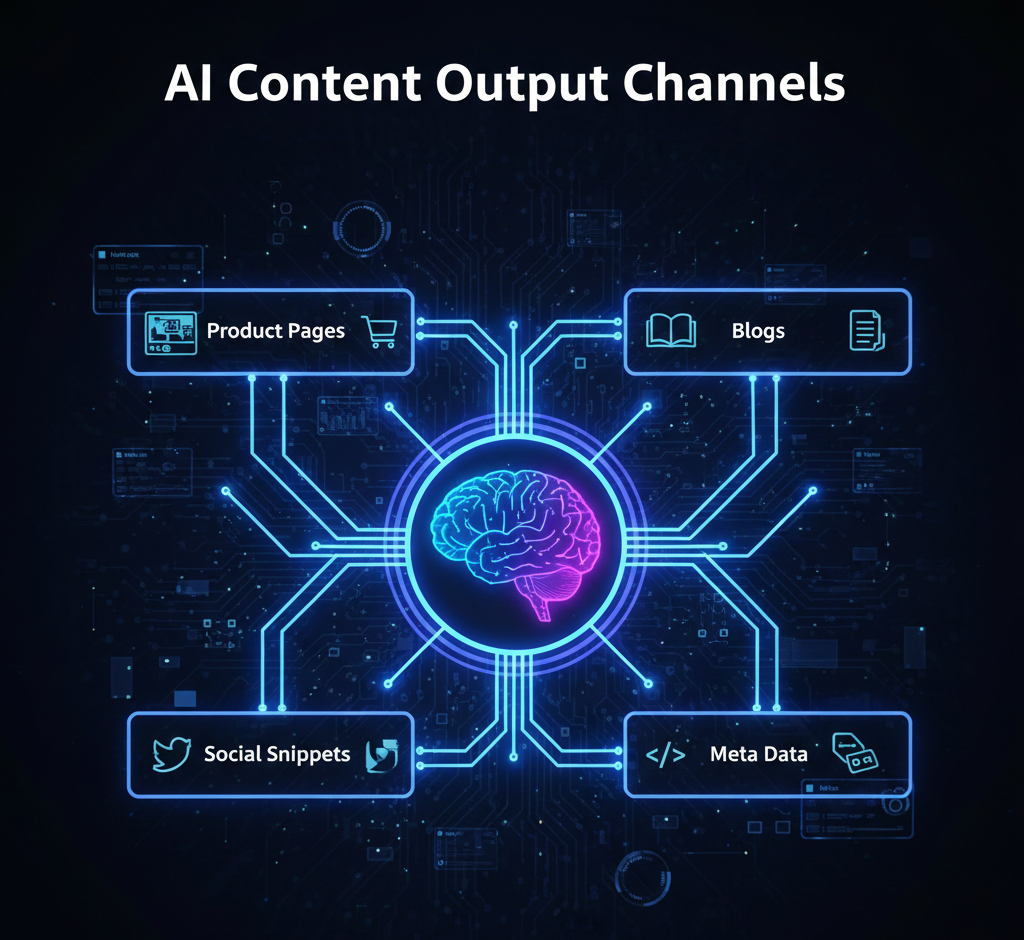
The secret to success in 2026 is efficiency through intelligent automation. You don’t need to manually write 100 different articles for 100 different platforms or product variations. You need a centralized “Content Engine” that generates optimized content at scale while maintaining quality and consistency.
eShopSEO helps you build this engine using advanced AI systems specifically trained for e-commerce optimization. By creating high-quality “seed content” – detailed product information, brand voice guidelines, and target keyword strategies – and using our automated platform, you can efficiently generate:
- Structured data markup for traditional search engines and AI crawlers
- Conversational answers optimized for AI-generated overviews
- Detailed buying guides and comparison content for human shoppers
- Social media snippets for discovery on new platforms
- Email marketing content that maintains consistent messaging
This centralized approach ensures consistency across all customer touchpoints while dramatically reducing the time and resources required to maintain comprehensive optimization.
The Future of E-Commerce Search
It’s Not SEO vs AI – It’s SEO for AI
The most common mistake brands make is thinking that AI search replaces traditional SEO. In reality, AI search optimization for ecommerce is simply the newest, most advanced evolution of SEO principles that have always mattered. The fundamentals of authority, clarity, trustworthiness, and user-centricity have not changed – but the “gatekeepers” evaluating these qualities have evolved.
In the past, the gatekeeper was a mathematical algorithm that primarily counted and evaluated links, keyword density, and domain age. Today, the gatekeeper is a sophisticated neural network synthesizing information from thousands of sources, evaluating context and nuance, and making judgment calls about which sources are most helpful for specific user needs. To pass this new gatekeeper, you must be the most helpful, most accurate, and most “readable” source in your niche – for both humans and machines.
The brands succeeding in this environment aren’t abandoning SEO best practices; they’re extending them. They’re adding structured data to their already well-optimized content. They’re creating comprehensive resources that serve both search ranking algorithms and AI citation algorithms. They’re building user experiences that satisfy both human visitors and the AI systems that refer those visitors.
Final Takeaway
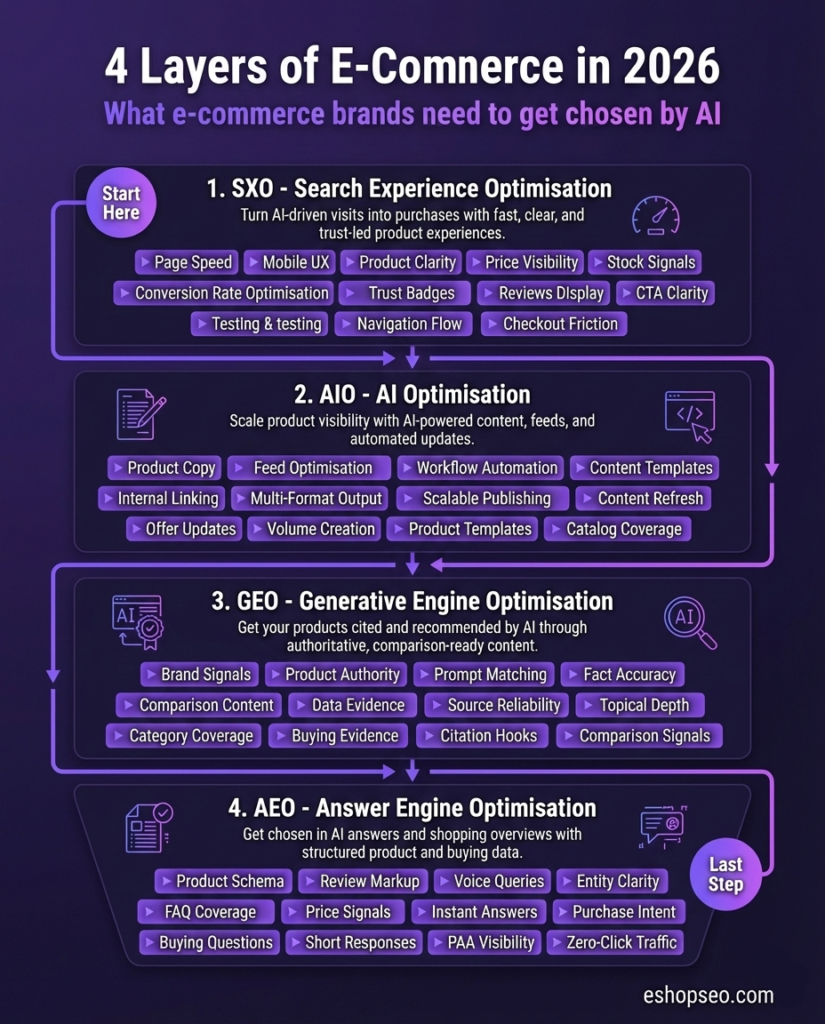
The brands that will dominate e-commerce in 2026 and beyond are those that move from being merely “searchable” to becoming truly “recommendable” by AI systems. This transformation requires attention to all four layers: Search Experience (SXO), AI Automation (AIO), Generative Citations (GEO), and Answer Engine Optimization (AEO).
Each layer builds upon the others, creating a comprehensive optimization strategy that addresses the full spectrum of how modern consumers discover, evaluate, and purchase products online. Neglecting any single layer creates vulnerabilities that competitors can exploit and limits your overall visibility in an increasingly AI-mediated marketplace.
Our platform offers advanced solutions for automated SEO content creation, specifically designed to increase organic traffic and improve rankings across traditional search engines and AI-powered answer engines. We focus on structured, reliable content production that enhances your e-shop’s presence across all AI tools and search platforms while maintaining the authenticity and trustworthiness that modern consumers demand.
Frequently Asked Questions
What is the difference between traditional SEO and AI search optimization for e-commerce?
Traditional SEO focuses on ranking your website in search engine results pages (SERPs) to drive clicks to your site. AI search optimization goes beyond visibility – it ensures your products and content are selected, cited, and recommended by AI engines like ChatGPT, Google AI Overviews, and Perplexity. In 2026, many users never click through to websites because AI provides direct answers and product recommendations within the search interface itself. Success now means being “recommendable” by AI, not just searchable by humans.
What are the 4 layers of AI search optimization and why do I need all of them?
The 4 layers are: SXO (Search Experience Optimisation) – ensuring fast, user-friendly pages that convert visitors; AIO (AI Optimisation) – automating content creation and optimization at scale across your entire product catalog; GEO (Generative Engine Optimisation) – making your content citation-worthy so AI engines reference you as an authoritative source; and AEO (Answer Engine Optimisation) – structuring data so AI can extract and present your products as direct answers. These layers are interdependent – skipping any one undermines your overall strategy and leaves competitive gaps.
How does Schema markup help my e-commerce store get recommended by AI?
Schema markup provides AI engines with structured, machine-readable data about your products, prices, availability, reviews, and specifications. When you implement Product Schema and Review Schema using JSON-LD format, AI can instantly verify facts, compare your offerings against competitors, and confidently recommend your products. Without schema markup, AI engines may miss critical information or extract incorrect data, significantly reducing your chances of being cited or recommended.
What is “zero-click” search and how does it affect my e-commerce business?
Zero-click search occurs when users get complete answers directly within the search interface without clicking through to any website. For example, when someone asks a voice assistant “find me running shoes under $100 with good ankle support,” the AI provides a direct product recommendation. If your products aren’t optimized for Answer Engine Optimisation (AEO) with proper structured data and comprehensive information, you won’t appear in these recommendations – effectively losing sales to competitors who have implemented the 4-layer framework.
How can I tell if AI engines are citing my e-commerce store as a source?
Test your visibility by asking AI platforms like ChatGPT, Perplexity, or Google AI specific questions about your product category: “What are the best [your product category] for [specific use case]?” Check if your brand appears in the generated answer or cited sources. Use different variations and competitor comparisons. Additionally, monitor your referral traffic sources in Google Analytics for visits from AI platforms, and track whether your content appears in Google AI Overviews for your target keywords.
Do I need to manually optimize every product page, or can this be automated?
Manual optimization becomes impossible at scale, especially for stores with hundreds or thousands of SKUs. This is precisely why AI Optimisation (AIO) – the second layer – is essential. Modern AI-powered platforms can automatically generate unique, SEO-optimized product descriptions, implement schema markup, create internal linking structures, and keep content fresh across your entire catalog. The key is choosing a solution that prioritizes accuracy over volume, uses human-in-the-loop quality controls, and maintains consistency with your brand voice while ensuring every product is optimized for both traditional search engines and AI recommendation systems. eShopSEO can help you with that with its tool the SEO Optimizer for ecommerce websites that rewrites your product or category description + meta in one click!