
The landscape of digital marketing is undergoing a seismic shift. For decades, brands obsessed over the “Blue Links” of Google, but today, the battleground has moved to conversational interfaces powered by artificial intelligence. As users increasingly turn to Large Language Models (LLMs) like ChatGPT, Perplexity, and Google’s AI Overviews for instant answers, understanding the relationship between AI citations and brand visibility has become the single most important factor for modern growth.
The stakes are clear: Nearly 60% of all Google searches now end without a single click to any website. According to Semrush’s 2025 zero-click study, 58.5% of US searches and 59.7% of EU searches conclude entirely within the search results page. For e-commerce businesses, this represents both a crisis and an opportunity. It is no longer enough to be “ranked”—your brand must be “cited” by AI engines to survive in this zero-click era.
The New Era of AI Citations and Brand Visibility
We have entered the age of the Generative Engine. Whether it’s Perplexity, Gemini, or Google’s Search Generative Experience (SGE), these engines don’t just provide lists—they synthesize information and provide definitive answers. If your brand isn’t part of that answer, you essentially don’t exist for a rapidly growing segment of the market.
How Digital Word of Mouth Transforms Brand Discovery
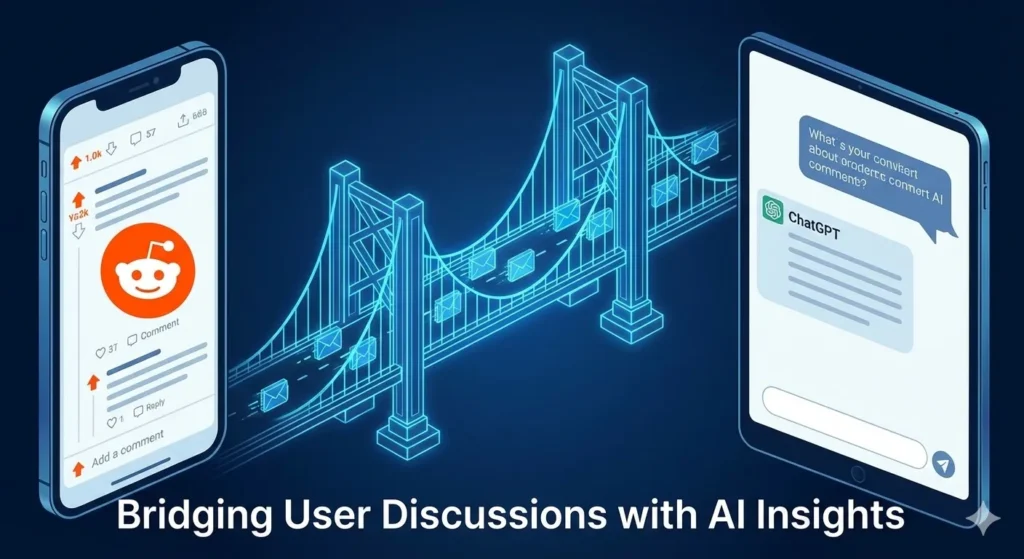
Digital word of mouth has fundamentally evolved. It used to mean a customer leaving a review on Yelp or a comment on a blog. Today, digital word of mouth serves as the primary fuel for user-generated content AI training. When a user on Reddit recommends specific software or a skincare routine, that data point is ingested by AI models during their training phases.
When the AI is later asked for a recommendation, it synthesizes these human conversations into citations and recommendations. This creates a powerful cycle where community trust directly translates into AI-driven visibility. Brands like Cetaphil have already capitalized on this shift, launching pilot campaigns specifically designed to increase visibility within Google’s AI Overviews around non-branded searches like “how to get rid of dry flaky skin on face.”
The Princeton Study Revolution in Conversational Authority Optimization
A groundbreaking study from researchers at Princeton University, Georgia Tech, Allen Institute for AI, and IIT Delhi introduced the concept of GEO (Generative Engine Optimization). Published in 2024 and tested across multiple AI platforms, this study changed the game by proving that visibility in AI responses isn’t random or luck-based.
The research team analyzed nine distinct optimization methods and discovered that specific techniques—particularly adding authoritative citations combined with statistics and expert quotations—can boost a brand’s visibility in AI-generated responses by up to 40%. This peer-reviewed research represents the first systematic approach to conversational authority optimization and provides a data-backed roadmap for the future of search visibility.
Understanding AI Answer Engine Marketing Fundamentals
To master this new domain, we must first redefine our vocabulary. AI answer engine marketing is the practice of optimizing content specifically for synthesis by generative models rather than just indexing by traditional search crawlers.
From Search Rankings to AI Citations
In traditional SEO, a “ranking” is simply a position on a search results page. In the world of AI-powered search, a “citation” is a direct endorsement. When ChatGPT or Perplexity provides a response, it often includes inline citations or source links to validate its claims. Being selected as the source for a high-value query is the new “Position Zero.”
These AI citations carry substantially more weight than standard backlinks because the AI has already “vetted” the information for the user, effectively providing a pre-validated recommendation. The click-through rate from AI Overview sources hovers around just 1%, but the brand visibility and trust-building impact is immeasurable—users remember which brands the AI recommended, even if they don’t click immediately.
Why Traditional SEO Falls Short for Conversational AI
Traditional SEO focuses heavily on keyword density, backlink quantity, meta tags, and technical site health. While these fundamentals still matter for traditional search, they don’t adequately address how an LLM understands “truth” or “authority.”
An LLM evaluates content based on narrative flow, factual data density, conversational tone, and the consensus found across community discussions. If your content is optimized for keyword-matching bots but lacks the human-centric authenticity found in citation-worthy content marketing, generative engines will likely bypass it entirely.
The Role of User-Generated Content in AI Training
AI models are trained on massive datasets scraped from the public internet, and a significant portion comes from user-generated content platforms like Reddit, Quora, Stack Overflow, and niche forums. This makes user-generated content AI training a critical pillar of modern visibility strategy.
If your brand is frequently discussed in positive, authoritative contexts on Reddit—where users share genuine experiences and recommendations—the AI perceives your brand as a “consensus choice” backed by social proof. This digital word of mouth acts as a credibility signal that no amount of paid advertising can authentically replicate.
Reddit’s importance has grown exponentially: it’s now the second most visited site via U.S. search traffic, and LLMs actively reference Reddit threads when answering conversational queries about product recommendations, troubleshooting, and “best of” comparisons.
The Princeton Study Blueprint: 9 Techniques for Maximum AI Citations
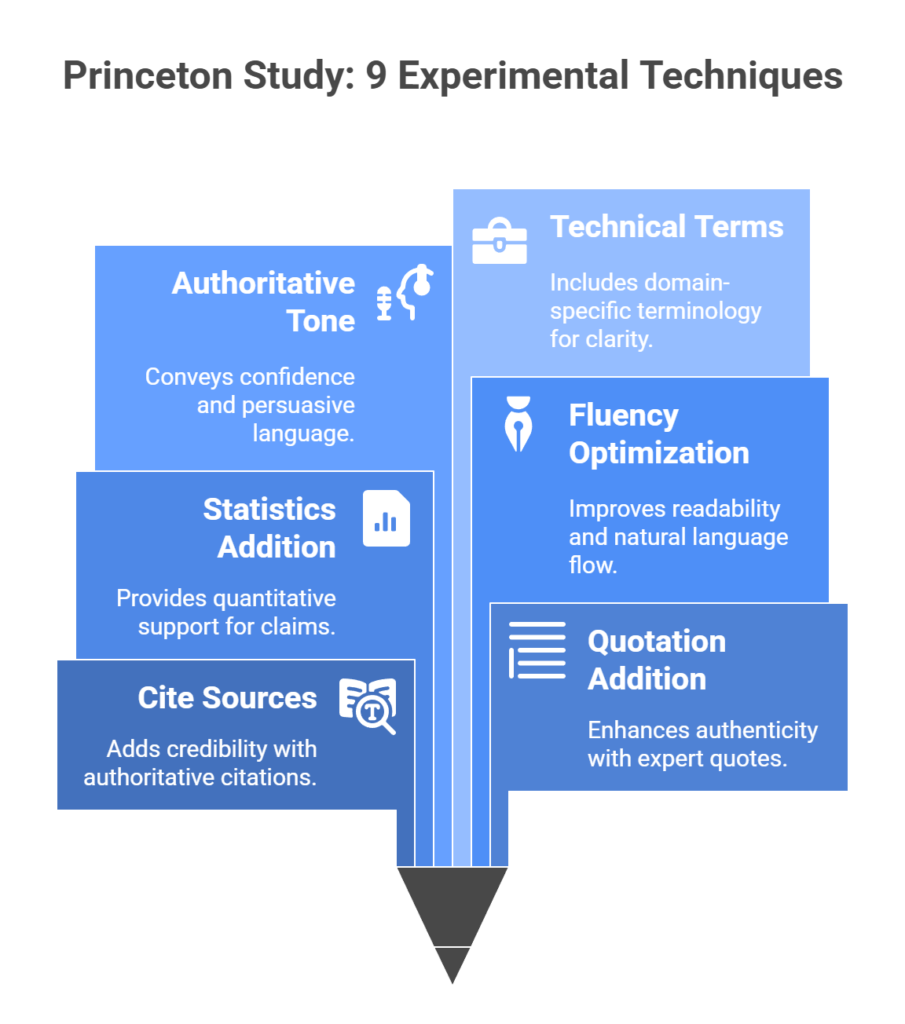
The Princeton-led GEO study identified nine specific techniques that demonstrably improve visibility in generative engine responses. Let’s examine the most impactful methods.
1. Authoritative Source Citations for 40% Visibility Gains
The most significant finding of the study was that citing authoritative sources within your own content can lead to visibility improvements of up to 40% when combined with other techniques. By linking your claims to reputable academic studies, government data, industry research reports, or recognized thought leaders, you make your content inherently more “trustworthy” to AI systems.
The engine interprets your page as a well-researched information hub rather than promotional content, making it a prime candidate for citation in generated answers. This aligns perfectly with Google’s E-E-A-T guidelines, which emphasize demonstrable expertise and trustworthiness.
2. Statistics and Quantitative Data Integration
AI models prioritize numerical data because it provides objective, verifiable facts that ground their responses. Instead of generic claims like “Our software is fast,” data-driven statements like “Our platform reduces page load time by 34% compared to industry averages” make your content highly extractable for AI answers.
The Princeton study confirmed that adding statistics significantly improved citation rates, particularly when combined with authoritative sources. Quantitative data serves as concrete evidence that AI can confidently reference.
3. Expert Quotations and Conversational Authority
Including direct quotes from verified subject matter experts adds a critical layer of conversational authority optimization. It signals to AI that the information isn’t generic text scraped from multiple sources but is backed by identifiable human expertise with credentials.
This technique directly supports the “Expertise” component of Google’s E-E-A-T framework. When your content features quotes from recognized industry professionals, researchers, or practitioners, it demonstrates first-hand knowledge and authority.
4. Fluency and Readability Optimization for AI Comprehension
If an AI struggles to parse your sentence structure or encounters ambiguous phrasing, it won’t cite you. Fluency optimization involves using clear, logical structures with proper grammar while avoiding unnecessary jargon or overly complex sentences.
The goal is maximum “digestibility” for a machine attempting to summarize information for human consumption. Content should flow naturally, with smooth transitions and coherent arguments that AI can easily extract and reformulate.
5. Structured Data and FAQ Schema Implementation
While modern LLMs excel at understanding unstructured text, implementing Schema.org markup—particularly FAQ schema and Product schema—still provides substantial advantages. Structured data offers a clear “map” that defines what constitutes a product, a review, a factual claim, or a frequently asked question.
For e-commerce specifically, enhanced product metadata including materials, dimensions, care instructions, sustainability markers, and availability dramatically improves AI-driven filtering and recommendation accuracy. This structured approach is foundational for AI answer engine marketing success.
Building Citation-Worthy Content Marketing Strategies
To capitalize on these research findings, you need a proactive, systematic strategy for citation-worthy content marketing.
Creating Reddit-Ready Content for AI Training Data
Since Reddit serves as a primary source for AI training data, your content strategy must include creating resources that Reddit communities genuinely want to reference and discuss. This doesn’t mean spamming subreddits with promotional links—that approach backfires spectacularly.
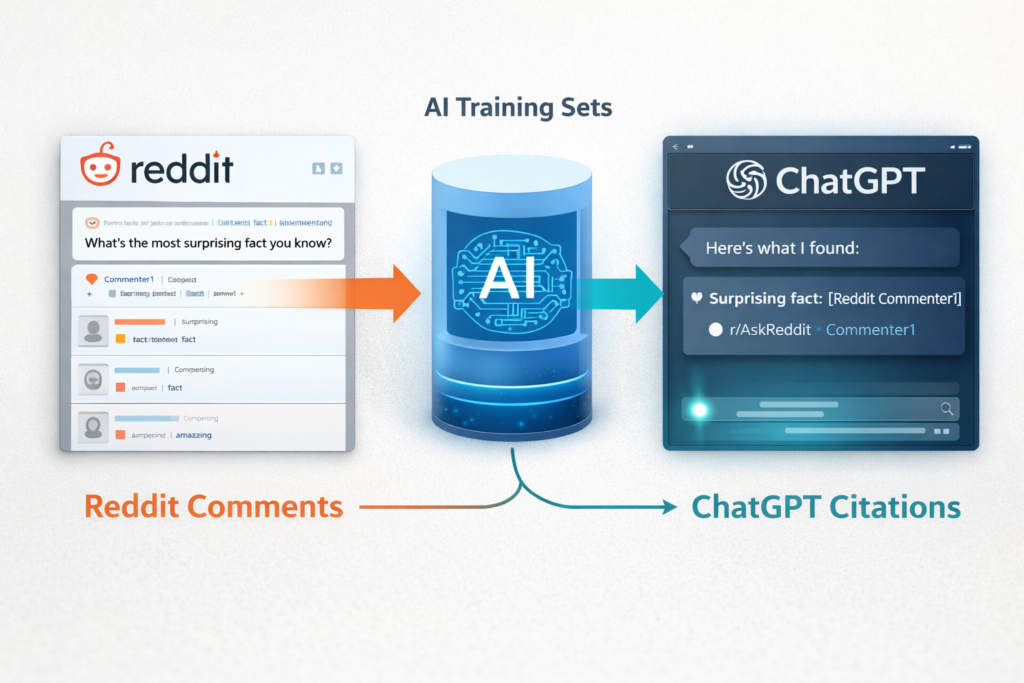
Instead, focus on creating high-value resources like comprehensive guides, original research, data visualizations, or tools that solve real problems. When Redditors organically link to your whitepaper or reference your study in discussions, those signals become embedded in the next generation of AI training data. You’re essentially seeding the future knowledge base of AI systems.
Source Diversity Across Platforms and Communities
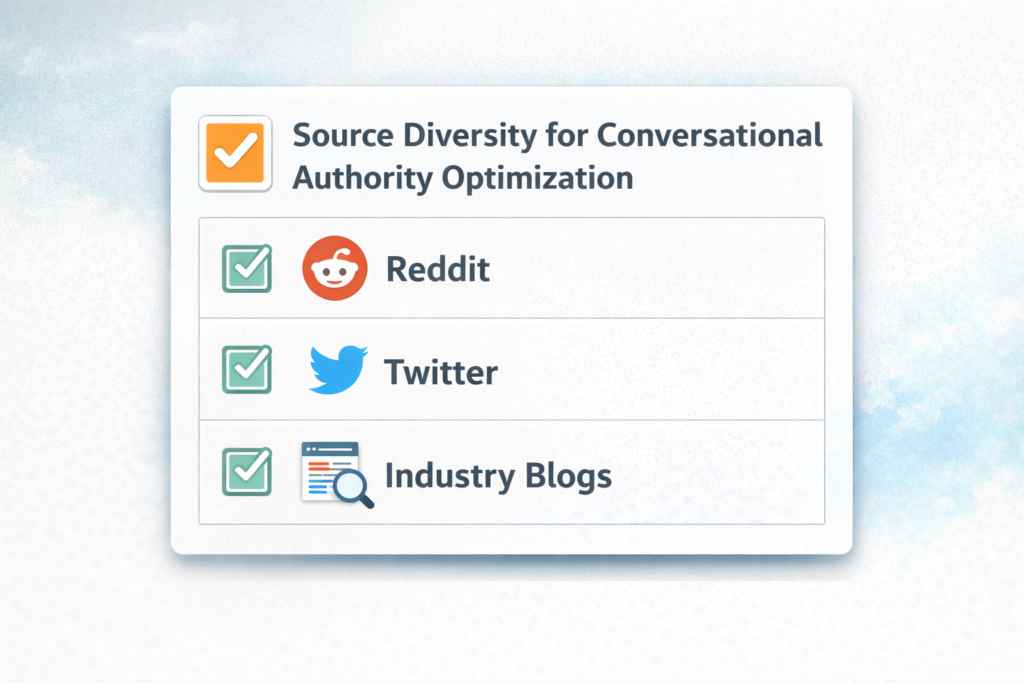
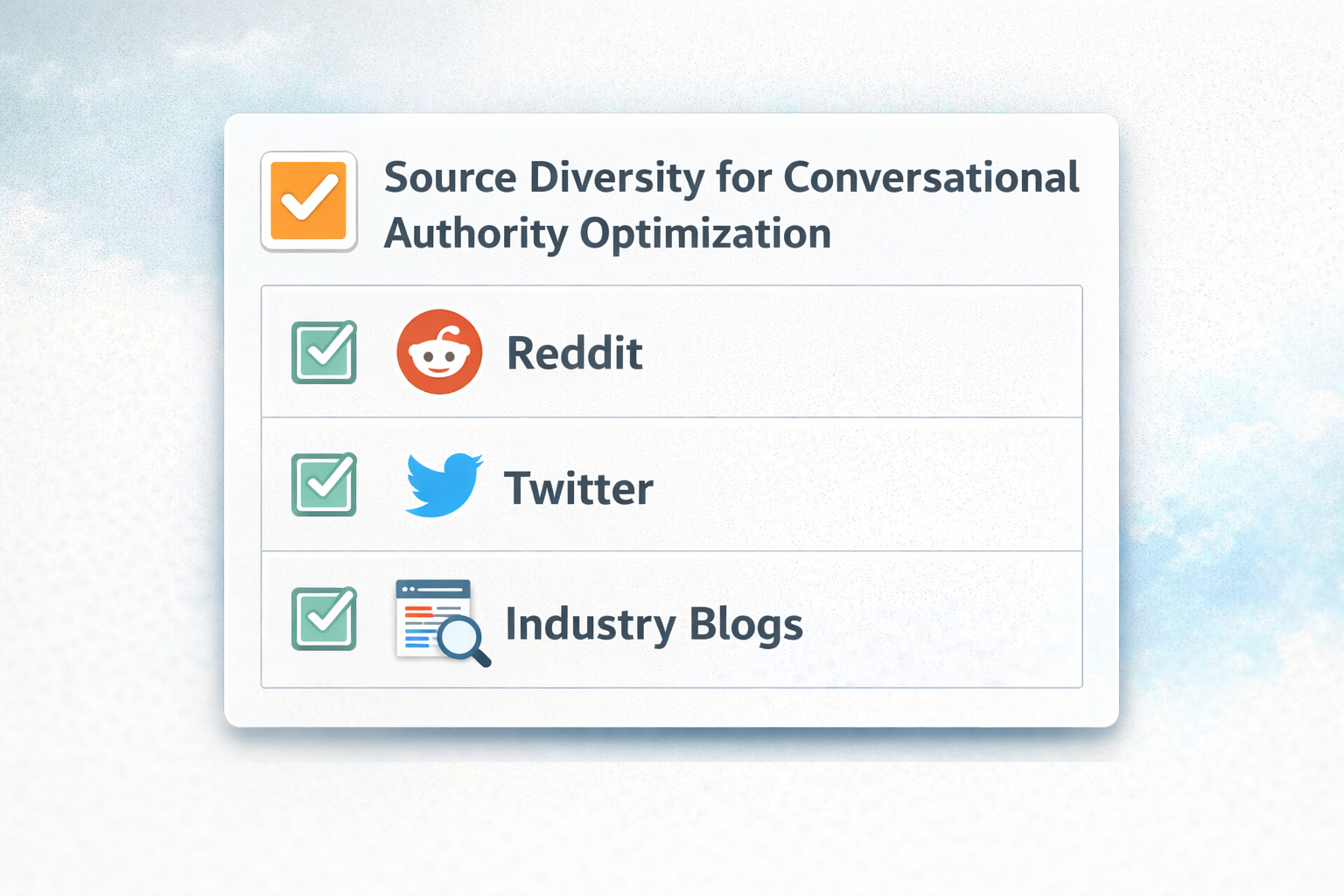
AI engines don’t evaluate your website in isolation—they look for consensus signals across the entire digital ecosystem. This is where source diversity becomes critical. Your brand needs authentic mentions across:
- Industry news publications and trade journals
- Niche forums and communities (Reddit, Discord, specialized forums)
- Review platforms (Trustpilot, G2, Capterra)
- Academic papers or professional journals
- Social media conversations (LinkedIn, Twitter/X)
This diversity proves to AI that your brand represents a recognized authority validated by multiple independent sources. For e-commerce brands, this means investing in genuine customer reviews, earning coverage in product roundups, and participating authentically in community discussions.
Implementing a Multi-Platform Visibility Strategy
In the zero-click era, visibility doesn’t always translate to immediate website clicks. Nearly 60% of searches now end without any click, but brands featured in AI Overviews and generative responses gain substantial trust, recognition, and branded search volume that converts at higher rates later in the customer journey.
This requires measuring success differently. Instead of obsessing over click-through rates, track:
- AI citation frequency: How often your brand appears in AI-generated answers
- Share of voice: Your brand’s mention rate compared to competitors in AI responses
- Brand search lift: Increases in branded searches following AI exposure
- Conversion quality: Higher intent and conversion rates from users who found you via AI citations
Synergistic Combinations: Maximizing Your AI Citations and Brand Visibility
The Princeton study revealed that these optimization techniques don’t work in isolation—they’re multiplicative when combined strategically.
The Power Quartet: Citations, Statistics, Quotations, and Fluency
When you combine Authoritative Source Citations, Statistical Data, Expert Quotations, and High Fluency, you create what researchers call a “synergistic effect.” This combination consistently delivered the most significant results in the study, pushing visibility improvements into the 31-40% range across different AI platforms.
This Power Quartet provides AI systems with everything they need to confidently cite your content:
- Proof (authoritative citations that validate claims)
- Data (statistics that provide concrete evidence)
- Authority (expert quotations that demonstrate expertise)
- Accessibility (fluent writing that’s easy to parse and summarize)
Measuring Your 31-40% Improvement Potential
Unlike traditional SEO where you track keyword rankings in Google Search Console, GEO requires monitoring “share of voice” across AI platforms. Use tools to systematically query LLMs about your industry, product categories, and use cases, then track how frequently your brand appears in responses and with what context.
According to recent research, brands that implemented comprehensive GEO strategies saw AI mention rates increase 31-40% within 3-6 months. This translates to substantial brand visibility gains, even if traditional click metrics temporarily decline due to zero-click search growth.
Real-World Success: Cetaphil’s AI-First Approach
Cetaphil provides a compelling case study in GEO execution. The skincare brand launched a targeted campaign to increase visibility within Google’s AI Overviews, specifically around symptom-driven, non-branded searches like “how to get rid of dry flaky skin on face.”
Rather than optimizing for clicks, Cetaphil focused on having its products mentioned in the AI-generated summaries themselves. By restructuring content to include dermatologist quotes, clinical study data, and comprehensive ingredient explanations, they successfully positioned their products as the authoritative answer the AI would cite. This strategy particularly resonated with Gen Z consumers who increasingly bypass traditional search entirely in favor of AI-powered answers.
Implementation Guide: From Strategy to AI Answer Engine Marketing Results
Ready to transform your visibility in the age of AI-powered search? Follow this systematic framework.
Phase 1: Audit and Assessment (Weeks 1-4)
Objectives: Understand current zero-click exposure and AI citation baseline
Actions:
- Audit SERP features for your top 100 target keywords
- Calculate current zero-click rate by content type using Google Search Console data
- Map citation frequency across AI platforms (ChatGPT, Perplexity, Google AI Overviews)
- Document competitor positioning in AI-generated responses
- Establish new KPI baselines beyond traditional traffic metrics
Deliverables:
- SERP feature audit spreadsheet
- Zero-click vulnerability assessment by product category
- Competitive AI positioning analysis
- New measurement framework documentation
Phase 2: Content Optimization (Weeks 5-12)
Objectives: Transform existing content to be citation-worthy
Actions:
- Inject authoritative citations: Add minimum 3-5 reputable sources per pillar page
- Data-ify qualitative claims: Convert “best-selling” to “rated 4.8/5 by 2,847 customers”
- Integrate expert quotations: Include industry expert, dermatologist, or technician quotes
- Simplify for fluency: Run content through readability tools targeting Grade 8-10 reading level
- Implement FAQ schema for common customer questions
Deliverables:
- Optimized content following the Power Quartet framework
- Structured data implementation across product and content pages
- FAQ sections addressing conversational queries
Phase 3: Off-Site Authority Building (Weeks 13-26)
Objectives: Build diverse citation sources across the digital ecosystem
Actions:
- Develop Reddit-ready resources (guides, tools, original research)
- Earn coverage in industry publications and product roundups
- Encourage authentic customer reviews on trusted platforms
- Participate genuinely in niche communities and forums
- Build relationships with industry experts for quotable insights
Deliverables:
- Multi-platform mention tracking dashboard
- Community engagement playbook
- Expert contributor network
Phase 4: Measurement and Iteration (Ongoing)
Objectives: Track AI visibility improvements and refine strategy
Actions:
- Monitor share of voice in AI responses monthly
- Track brand search lift following AI exposure
- Measure conversion rate and quality from AI-referred traffic
- Test AI platforms regularly for accuracy of brand information
- Refine content based on which topics earn citations
Deliverables:
- Monthly AI visibility report
- Conversion quality analysis
- Continuous optimization roadmap
E-E-A-T Compliance and Trust Signals for AI Visibility
Google’s E-E-A-T framework (Experience, Expertise, Authoritativeness, Trustworthiness) has become increasingly important as AI systems filter training data. Here’s how to ensure your content meets these standards:
Experience
Demonstrate first-hand experience with products or services. Include case studies, before/after examples, usage photos, and specific details that only someone with direct experience would know.
Expertise
Feature content created or reviewed by subject matter experts with verifiable credentials. Include author bios, professional certifications, and links to expert contributors’ profiles.
Authoritativeness
Build recognition as a go-to source through consistent, high-quality content, industry citations, expert contributions, and mentions in authoritative publications.
Trustworthiness
Maintain website security (SSL certificates), provide transparent contact information and policies, fact-check all claims, and promptly correct any errors with transparency.
Google explicitly advises against publishing fully AI-generated content without human review. AI can assist with research and drafting, but final content must demonstrate original human expertise and perspective aligned with E-E-A-T principles.
Your Path to Enhanced AI Citations and Brand Visibility
The shift from search engines to answer engines represents the biggest change in digital marketing since mobile-first indexing. By moving beyond traditional SEO tactics and embracing conversational authority optimization, you’re future-proofing your brand for the AI-native generation of consumers.
The data is unambiguous: nearly 60% of searches now end without a click, AI Overviews grew 102% in just Q1 2025, and major publishers like HubSpot experienced 70-80% organic traffic declines due to zero-click search. The question isn’t whether to adapt—it’s how quickly you can implement GEO strategies before competitors capture your share of AI-driven visibility.
Think of GEO as the convergence of citation optimization, conversational authority, and source diversity. When you optimize to be referenced by AI—not just ranked by algorithms—you tap into a proven 31-40% visibility boost that translates to brand recognition, trust-building, and higher-quality conversions even in a zero-click world.
Start by auditing your most important pages today. Add the statistics, cite the experts, integrate the data, and simplify the language. The AI is reading your content right now—make sure it has something worth citing.
Frequently Asked Questions (FAQ)
Q: What exactly are zero-click searches and why do they matter?
A: Zero-click searches occur when users find complete answers directly on the search results page without clicking through to any website. According to Semrush’s 2025 study, 58.5-59.7% of all searches now end this way. They matter because traditional traffic-focused SEO strategies become less effective, requiring brands to optimize for visibility and citations within AI-generated results rather than just website visits.
Q: How is GEO (Generative Engine Optimization) different from traditional SEO?
A: Traditional SEO optimizes for search engine rankings to drive website clicks, focusing on keywords, backlinks, and technical site health. GEO optimizes for being cited by AI engines (ChatGPT, Perplexity, Google AI Overviews) in their generated answers, focusing on authoritative citations, statistics, expert quotes, conversational content, and multi-platform presence. SEO is traffic-centric; GEO is influence-centric.
Q: Does the 40% visibility boost apply to all industries?
A: The Princeton study tested GEO techniques across diverse topics and found consistent improvements, with combined optimization techniques (citations + statistics + quotations + fluency) delivering 31-40% visibility gains. Results vary by industry competitiveness and content quality, but the fundamental principles apply universally since all AI platforms prioritize authoritative, well-cited, data-rich content.
Q: Will zero-click searches kill my e-commerce business?
A: Not if you adapt strategically. While zero-click searches reduce immediate traffic, brands featured in AI answers gain substantial trust, recognition, and branded search volume that converts at higher rates. Cetaphil and other early adopters demonstrate that optimizing for AI citations drives brand awareness that ultimately leads to conversions. The key is measuring success through AI visibility metrics, not just click-through rates.
Q: How important is Reddit for AI visibility?
A: Extremely important. Reddit is the second most visited site via U.S. search traffic, and LLMs actively reference Reddit threads when answering conversational queries about products, troubleshooting, and recommendations. AI models train on user-generated content from Reddit, making authentic community discussions a critical signal of brand credibility. Focus on earning genuine mentions by providing value, not spamming communities.
Q: Can I use AI to write content for GEO?
A: AI can assist with research and drafting, but Google explicitly advises against publishing fully AI-generated content without substantial human review and editing. Your content must demonstrate original human expertise, first-hand experience, and E-E-A-T principles (Experience, Expertise, Authoritativeness, Trustworthiness). AI-assisted content that lacks genuine expertise and fact-checking will be filtered out by both search engines and AI training data curation.
Q: How do I measure GEO success?
A: Track these key metrics instead of traditional rankings: (1) AI citation frequency—how often your brand appears in AI-generated answers, (2) Share of voice—your mention rate vs. competitors in AI responses, (3) Brand search lift—increases in branded searches following AI exposure, (4) Conversion quality—higher intent and rates from AI-referred traffic, and (5) Accuracy monitoring—regularly testing AI platforms for correct brand information.
Q: How long does it take to see GEO results?
A: Most brands implementing comprehensive GEO strategies see measurable AI visibility improvements within 3-6 months. However, this varies based on current authority, content quality, and competitive landscape. The multi-phase implementation (audit, optimization, authority building, measurement) typically spans 6-12 months for full maturity, with early wins visible in weeks 8-12 as optimized content gets indexed and cited.
Q: Should I stop doing traditional SEO and focus only on GEO?
A: No—optimize for both. Traditional search still drives significant traffic (40-50% of searches still result in clicks), and many SEO fundamentals like backlinks, structured data, and site health also support GEO. The most successful strategy integrates both approaches: ensure your technical SEO foundation is solid while adding GEO-specific optimizations like citations, statistics, expert quotes, and conversational content structure.
Sources
- Princeton University Study – “GEO: Generative Engine Optimization”
- Semrush Zero-Click Search Study (2025)
- The Semrush data (58.5-59.7% zero-click rates) is cited in multiple industry analyses. A comprehensive summary with the original Semrush statistics can be found at:
- https://www.ekamoira.com/blog/zero-click-search-2026-seo
- DEPT Agency – “Zero-click searches and the future of e-commerce product discovery”
- Search Engine Land – “What is generative engine optimization (GEO)?”
- Google E-E-A-T Guidelines & Industry Analysis