
How Ecommerce SEO Has Changed
If you are still using an SEO playbook from a few years ago, you are already falling behind. In 2026, the ecommerce landscape has shifted from simple keyword matching to a complex world of semantic intent, AI Answer Engines (AEO), and rigorous EEAT standards.
In the opening chapter of our Ultimate Guide to Ecommerce SEO, we break down why keywords are becoming secondary to topical authority. We explore how AI systems like Perplexity and Gemini are changing the competition and provide a roadmap for building the Experience, Expertise, Authoritativeness, and Trust required to rank today. Learn how to transform your store from a simple product catalog into a high-trust authority that Google—and AI—confidently recommends to shoppers.
1. From Keywords to Intent and Entities
Old approach: Target “best running shoes” with exact-match keywords throughout your page, stuff headers with the phrase, and rank.
New reality: Google’s BERT, MUM, and modern AI models understand semantic relationships, synonyms, and context. Your page on “men’s trail running shoes” ranks for “best trail running footwear,” “men’s off-road running sneakers,” and dozens of related variations—even without using those exact phrases.
This means: Stop thinking about keywords. Start thinking about topics. Cover a subject comprehensively, use natural language, and let semantic relevance do the work.
2. AI Answer Engines Are Now Your Biggest Competitor
For the first time in search history, your competitors aren’t just websites ranking on Google. They’re AI systems generating answers directly in the search interface.
ChatGPT, Perplexity, Google Gemini, and others now:
- Answer questions without directing users to websites
- Extract product recommendations from multiple sources
- Create buying guides by synthesizing information from competitor sites
- And crucially: Recommend specific products without linking to them
Your rank #1 for “best running shoes for marathon training” doesn’t matter if ChatGPT synthesizes an answer that recommends your competitor’s product without ever mentioning your store.
This means: Your content must be AI-readable, structured, authoritative, and comprehensive.
3. EEAT Determines Everything
Google’s Search Quality Rater Guidelines now explicitly measure:
- Experience: Real user testimonials, authentic reviews, before/after proof
- Expertise: Demonstrated knowledge, certifications, detailed product education
- Authority: Backlinks from trusted sources, media mentions, external citations
- Trust: Security, transparency, responsive service, clear policies
For ecommerce, EEAT signals include:
- Customer reviews and ratings (verified purchases)
- Return/refund policies clearly stated
- Payment security badges
- Customer service responsiveness
- Product specification accuracy
- Author expertise (designer bios, certifications)
- Warranty and guarantee clarity
The three core pillars of modern ecommerce SEO are now:
- Technical Excellence – Fast, mobile-optimized, crawlable, indexed
- Content Authority – Comprehensive, unique, semantically relevant, AI-readable
- User Trust – Authentic reviews, clear policies, security, responsive support
The EEAT Framework for Ecommerce
EEAT isn’t a ranking factor you can “optimize” like keyword density. It’s a quality framework that determines whether Google trusts your site enough to rank it at all.
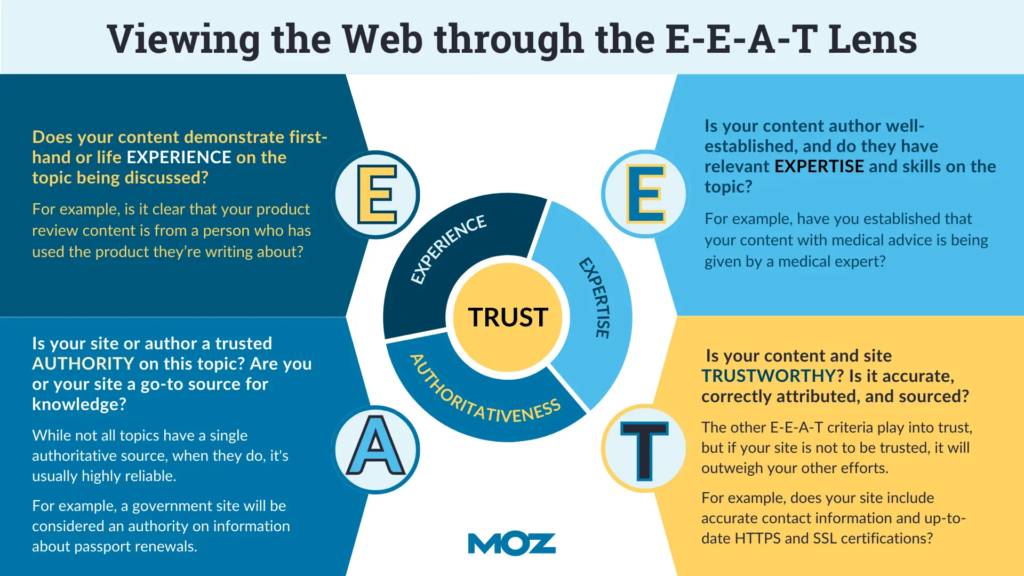
For ecommerce specifically, here’s how to build each pillar:
Experience
Experience signals come from real customer engagement and proof of use.
Actions:
- Collect and display customer review photos and videos (unboxing, product in use)
- Feature testimonials highlighting specific results or transformations
- Show customer-generated content prominently on product pages
- Include “As seen on” logos if featured in media
- Display customer stats (number of happy customers, repeat purchase rate)
Example: Instead of “Great product!” show “Sarah M. – Verified Buyer: ‘I ran three marathons in these shoes without blisters. Highly recommend for long-distance running.’”
Expertise
Expertise signals demonstrate deep knowledge of your products and industry.
Actions:
- Include author bios on product pages, guides, and reviews (credentials, certifications, experience)
- Create detailed buying guides explaining features, materials, benefits
- Publish comparison content showing detailed feature breakdowns
- Include specific product specifications (materials, dimensions, weights, certifications)
- Link to educational content (how to choose, care guides, troubleshooting)
- Partner with or feature industry experts (designers, athletes, specialists)
Example: Instead of generic product descriptions, include “This shoe features a 10mm gel cushioning in the heel, engineered for 5+ hour comfort intervals, based on 5 years of athlete feedback.”
Authority
Authority comes from external recognition and third-party validation.
Actions:
- Earn backlinks from industry publications and niche blogs
- Secure media coverage and press mentions
- Build partnerships with complementary brands
- Earn industry awards and recognition
- Display certifications relevant to your products
- Build a strong brand presence across platforms
- Contribute expert insights to industry conversations
Example: “Featured in Runner’s World Top 10 Running Shoes 2026” shown prominently on product pages.
Trust
Trust is the foundation—without it, nothing else matters.
Actions:
- Display security badges (SSL, PCI compliance, Verisign)
- Show trust signals prominently (verified reviews, return policy, money-back guarantee)
- Transparent pricing with no hidden fees
- Clear, detailed return/refund policies (60-day returns, no-questions-asked)
- Multiple payment options (credit card, PayPal, Apple Pay, Google Pay)
- Fast, transparent shipping (delivery timeframes shown before checkout)
- Responsive customer service (chat, email, phone availability listed)
- HTTPS on all pages (mandatory in 2026)
- Privacy policy and data security clearly explained
Example: Above the “Add to Cart” button: “60-day money-back guarantee | Free returns | 1-3 day delivery | SSL secure | Trusted by 50,000+ customers”
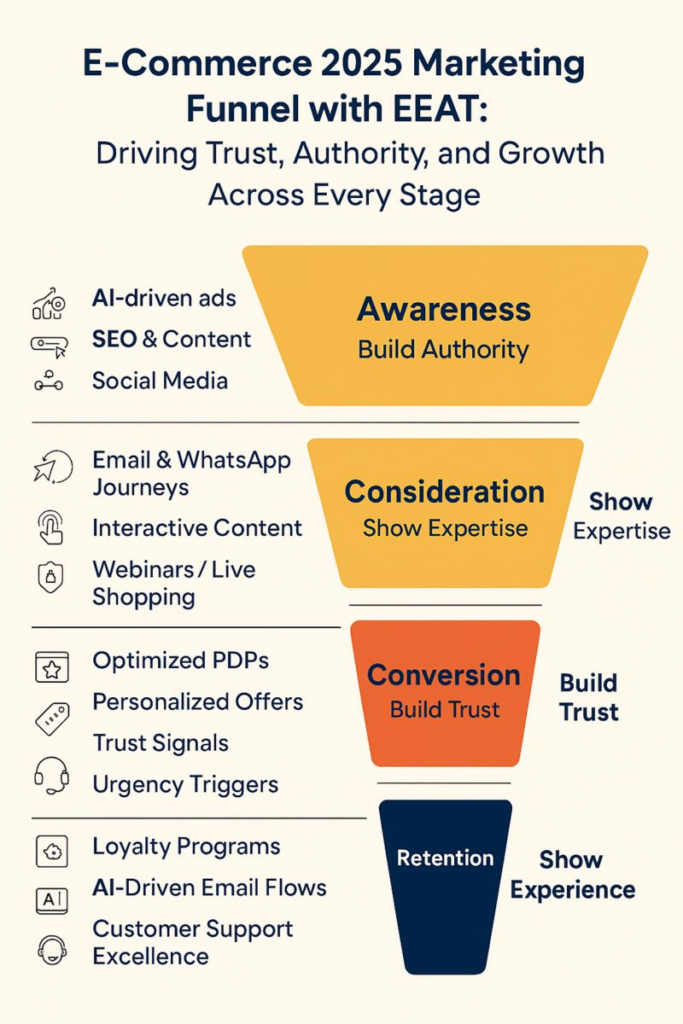
The infographic below illustrates the evolution of the customer journey, reimagining the traditional marketing funnel through the lens of the EEAT framework for 2026. Rather than focusing solely on traffic volume, this model prioritizes building Authority at the awareness stage via AI-driven ads and strategic content, ensuring that your brand is recognized as a leader before a user even clicks. As potential customers move into the consideration phase, the focus shifts to demonstrating Expertise through interactive content and personalized communication channels like WhatsApp, bridging the gap between interest and intent.
The bottom of the funnel emphasizes converting that intent into sales by establishing deep Trust using optimized product pages and verified security signals. Finally, the funnel extends into a retention phase where Experience is showcased through loyalty programs and AI-optimized support, turning one-time buyers into long-term advocates. This holistic approach ensures that every touchpoint—from the first impression to post-purchase support—is engineered to meet the high standards of both search engines and modern shoppers.
Google’s official ecommerce SEO documentation reinforces these EEAT principles, emphasizing that product page quality, structured data accuracy, and transparent policies are now baseline requirements for competitive ecommerce visibility. For stores looking to scale EEAT-compliant content efficiently, platforms like EshopSEO can automatically generate product-aware blog posts and buying guides that include proper internal linking to products and categories, helping build both expertise signals and topical authority across your domain.
Move on reading about: Part 2: Technical SEO – The Non-Negotiable Foundation